Wednesday, May 20, 2020

Leeky Abstraction Risotto

serves four as a main dish

1 cup uncooked Arborio or Carnaroli rice
1 1/2 cups minced white and light-green of leek
1/2 cup thinly sliced celery
12 oz cooked chicken sausage*, sliced thick
1 bunch swiss chard
1 cup chicken stock
1/2 cup dry white wine
1 quart or more boiling water**
1/2 cup grated cheddar cheese
olive oil
2 Tb unsalted butter
not-too-hot vinegar-based hot sauce - e.g., Cholula
salt
freshly ground black pepper

* See label photo for Whole Foods product I happened to use.
** I use an electric tea kettle for this.

Preheat the oven to 170 degrees F. Put soup plates in the oven to warm.***

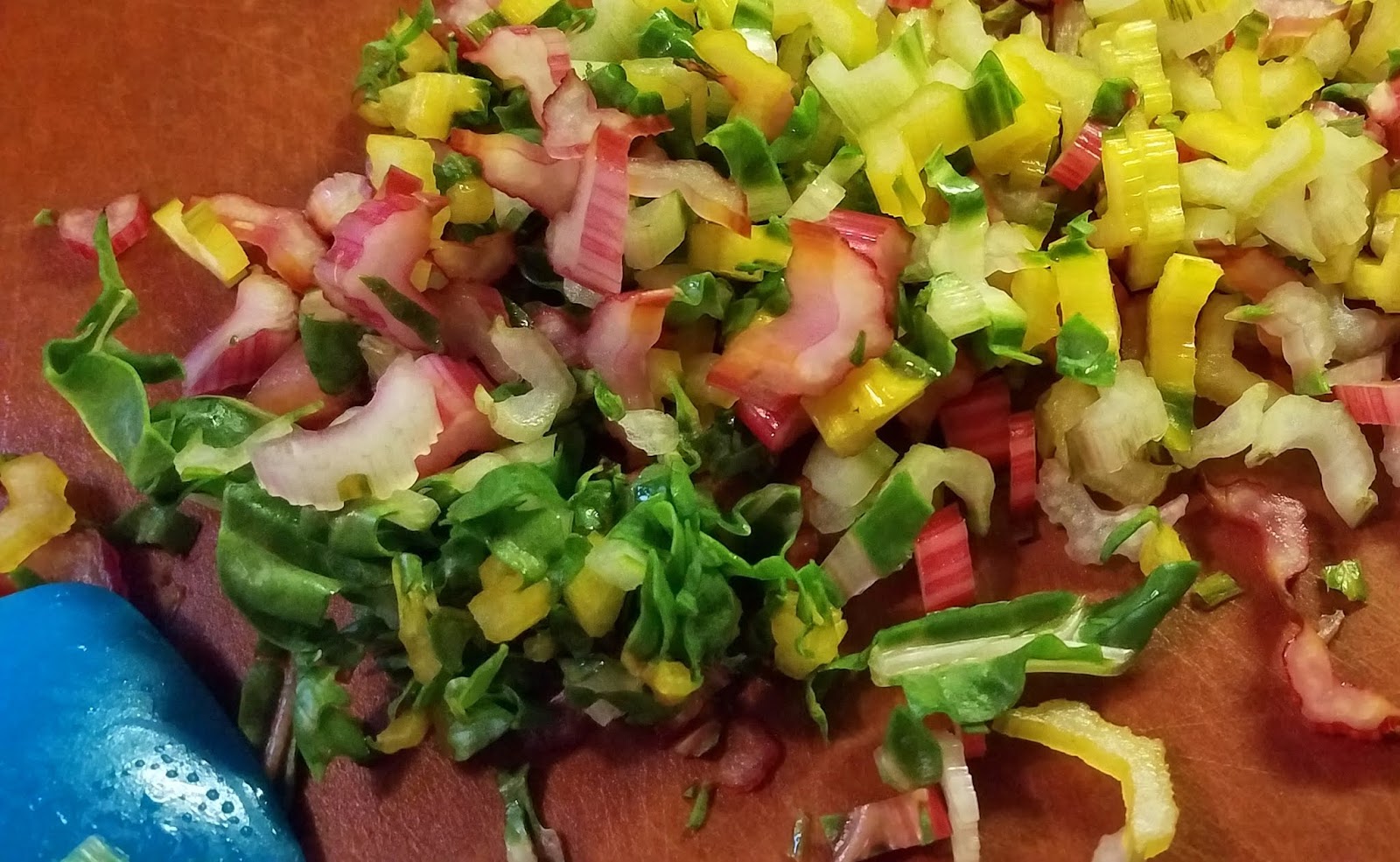
Separate the stems from the chard leaves. Chop the stems finely. Chop the leaves coarsely. Set both aside.

Heat a large dutch oven over a medium flame. When hot, add a couple Tb of olive oil, the leek, celery, sausage, and chard stems. Cook, stirring frequently, until the vegegables are translucent and tender but still toothsome and not dull colored. Transfer everything to a large plate and set aside.

Clean the pan and return to medium heat. When hot, add a couple Tb of olive oil and the rice. Stir. Cook until a few grains of the rice begin to turn a little bit tan. (I.e., the usual risotto shtick.) Add the chicken stock. Reduce heat to low. Cook until the stock is nearly absorbed. Continue the risotto routine with the boiling water. See Marcella Hazan or other authority if you don't know the routine.

When the risotto is five minutes away from being done,**** raise heat to medium. Stir in the reserved sausage and sauteed vegetables, plus the chard leaves. Continue cooking.

When the rice is barely done, remove from heat. Stir in the butter and cheese. Taste. Season accordingly with salt and pepper. Add add additional hot water if needed. (Risotto is always better too wet than too dry; too dry makes it gluey.) Serve on the heated soup plates. Top with dots of hot sauce.


*** If you serve this dish on cold plates you deserve a stint in the gulag.

**** Yes, I know that if you are not a risotto geek you will not know when "five minutes before being done" is, but then if you are not a risotto geek you almost certainly have given up on this recipe before now. (This is the leeky abstraction part.)


Improbably Satisfying Beans with Kale

serves four as a side dish
N.B. #1 This is a vegan recipe, but don't let that put you off.
N.B. #2 This is a variation on a NY Times recipe that I've misplaced.

4 cups chopped fresh kale, no stems
1 13oz package cooked cannelini beans
2 Tb minced garlic
2 Tb minced shallot
1/2 cup minced fresh Italian parsley
1/4 cup dry white or rose wine
1/2 cup cold water
1/2 tsp smoked paprika
Aleppo pepper*
freshly ground black pepper
coarse salt
1/2 lemon
6 Tb extra-virgin olive oil

* or substitute the more common "pizza house" hot pepper flakes

Preheat a large saute pan or dutch oven over a medium-low burner. When hot, add half the olive oil, the garlic, half the parsley, and the shallot. Toss. Cover and sweat for a couple of minutes. Remove cover and cook for a few more minutes until fragrant and no longer steaming. Do not allow to brown. Toss the beans into the mixture and cook slowly for 10 minutes or so, still without browning. Add Aleppo pepper to taste, and the paprika. Remove from heat and allow to sit at least 15 minutes for flavors to meld. The photo shows the dish at this point. Yum.


Return the pan to a medium-high burner. Add the water, wine, and kale. Allow the alcohol from the wine to evaporate - a minute or two. Cover and cook over medium heat until the kale wilts completely. Uncover and cook until kale is tender but has not acquired gray or other dull tones - keep tasting it. Remove from heat. Stir in the remaining parsley and remaining olive oil. Season to taste with salt, pepper, and lemon juice. Serve immediately on heated plates.

Saturday, June 20, 2015

Warm Scallop Salad with Rice Vinegar Guacamole and Beaujolais Blanc Pan Sauce


Serves 3 - 4


  • 20 oz fresh New England dry-pack sea scallops - about 16 scallops (the ones in the photo here were from New Bedford, Mass.)
  • 1 very ripe avocado
  • about 4 Tb best extra virgin olive oil
  • 1 small clove garlic, pressed
  • dash hot sauce
  • about 2 Tb rice vinegar
  • 3 Tb unsalted butter
  • about 1/2 cup dry white wine
  • 2 oz fresh kohlrabi bulb
  • very fresh mixed mild salad greens
  • sea salt
  • freshly ground black pepper
  • 1/2 fresh lemon


Shave the kohlrabi into very thin strips. (I used a mandoline.) Toss the strips with 1Tb of the rice vinegar and a little bit of salt. Set aside.

Approximately 20 minutes before you are going to cook them, pat the scallops dry with paper towels. Toss them with 2Tb of the olive oil and a small amount of salt and pepper. Set aside at room temperature.

Peel the avocado. Place in a small mixing bowl with the garlic, hot sauce, about 2Tb of the olive oil, and about 1Tb of the vinegar. Mash thoroughly with a fork. (Adjust the balance of oil and vinegar to taste. You want it slightly more tart than you might expect, to cut the richness of the scallops and the butter to come.) Season conservatively with salt and pepper.

Heat a large non-stick skillet to very hot over a high flame. Set the oiled scallops in the pan on the flat sides, with a little space between. When they start to brown on one side (see photo), turn each one using tongs. They are done when opaque all the way through. Taste one to make sure. This will probably take about 2 minutes per side. When done, set aside. Pour the wine into the pan and reduce by about a third. Remove pan from heat entirely. Whisk in in the butter. Add a few drops of lemon juice to taste.

Place the greens on plates. Decorate with the marinated kohlrabi. Place a large spoonful of the avocado mixture on each plate. Add scallops. Drizzle the pan sauce over the scallops and the salad.

Serve with French bread and a good white Burgundy. I used an awesome, affordable 2013 Beaujolais Blanc purchased at Rosemont Market in Yarmouth. It was $13.99 before any case discount.


Sunday, January 4, 2015

Red Pepper Velouté

This sauce is great to have around when you want to add some color and deep flavor to an otherwise too-neutral dish. For example, I made a particularly successful risotto tonight, partly because I threw in maybe a half cup of this good stuff.

1 large red bell pepper, chopped fine
1 large shallot, chopped fine
1 Tb flour
roughly 3/4 cup dry white wine
2 Tb olive oil
1 Tb balsamic vinegar
roughly 1/2 cup homemade chicken stock (optional, but desirable)
roughly 1/2 cup mild tomato sauce or purée (optional, but desirable)
salt
freshly ground black pepper

heavy-bottomed sauté pan or sauteuse, with cover
stick blender

Heat the saucepan over moderately high heat. Add the oil and the chopped pepper. Saute until slightly browned and giving off the characteristic "roasted red pepper" smell, about 5 min. Reduce heat to low. Stir in the shallot and cover. Sweat the shallot-pepper mixture until the shallots are soft and translucent, about more 5 min. Remove cover. Stir in the flour and cook for a couple of minutes. Stir in the wine, and the stock & tomato sauce, if using. Otherwise add some good water. Bring to a simmer, stirring frequently. Adjust thickness with stock / water to taste, always starting with less and adding more if needed. You are aiming for a rather thin sauce. Simmer over lowest heat, covered, for another 5 min. Puree thoroughly with the stick blender. Again adjust thickness with stock / water if needed. Season with salt and pepper. If it needs more brightness, stir in a few drops of freshly squeezed lemon juice and/or Louisiana-style hot sauce. Will keep in fridge for up to a week.


Thursday, October 30, 2014

How to Cook Rice

How to Cook Rice

My mother was an unremarkable cook, for the most part. She did have an easy and foolproof way to cook rice, however - one that I have used effectively my whole life. It pains me when people complain that they have trouble with this staple. Here then, from Janet S. to you, is how to cook rice.

(NOTE: This method is for making plain non-sticky long-grain white or brown rice. If you want to make risotto or rice for sushi or rice to eat with chopsticks or any other dish that calls for rice which coheres, this blog post is not the one you want.)


Rice
makes four large portions
  • 1.5 cups plain long-grain white or brown* rice - not par-boiled or otherwise adulterated
  • large covered saucepan or small stockpot (4 quarts)
  • large strainer or small-holed colander (see photo)
  • 2.5 - 3 quarts (10 - 12 cups) water
  • timer
Bring the water to a boil over high heat in the covered pot. The exact quantity is not critical, but it has to be a lot. Basically you're cooking rice exactly like you would cook pasta. If you don't have enough water it will become too starchy, and the rice will be sticky.

When the water is at a full rolling boil, remove the cover. Stir in the rice, using a wooden scraper or spoon to make sure none sticks to the bottom of the pan. For plain, jasmine, or basmati white rice, Start a timer set exactly 8 minutes. (*For brown rice, set it for 20 minutes.) Do not wait for the water to come back to a boil before starting the timer. The water should come back to a boil within about 30 seconds. If it doesn't, you didn't use enough water. Again move a wooden spoon around the bottom of the pot to make sure there is no stuck rice.

Boil uncovered until the timer goes off. Then do not dally. Spring into action and drain the rice into the strainer or colander. Allow all water to drip out. I think this is the place where most people are unprepared for this method of cooking rice: You need a strainer or colander that's big enough to hold a bunch of cooked rice but which has REALLY SMALL HOLES. Otherwise, obviously, you will end up with rice in the sink. Serve the rice immediately. If you need to hold it for five minutes you can do that by adding a quarter inch of hot tap water to the still-hot cooking pot. Then set the strainer filled with rice over the water and cover with the lid. Do not turn the heat on or you will steam the rice, overcooking it. Enjoy.


Sunday, January 13, 2013

Shrimp Kathy (Plus)


My cousin Kathy, who lives on the Florida panhandle, showed me how to poach shrimp very simply so that they come out tender and sweet every time. (Of course you have to start out with good raw material.) For this recipe, I've taken her basic approach and added a thin sauce that adds some complimentary flavors but doesn't overwhelm or cloy. After a couple of not-quite-there attempts, I'm pretty happy with it.


seconds?


serves 3
  • 1 lb 16 - 20 count Gulf shrimp, shell on
  • 1 cup beer
  • 3 cups water
  • ice
  • 1/2 tsp Old Bay seasoning (okay, purists, this is optional)
  • 3 Tb butter
  • 2 cloves garlic, sliced thin
  • 2 or 3 fresh basil leaves, cut fine (roll them up tightly together the long way, then slice the rolls crosswise with a sharp knife)
  • 1 Tb sherry vinegar
  • salt
  • freshly ground black pepper

Cooking the Shrimp

If you want to devein the shrimp, do so without removing the shells. Cooking with the shell on is key to good flavor here.

Bring the beer, water, a big pinch of salt, and the Old Bay (if using) to a boil over high heat in a covered saucepan. While the water is heating, fill a large mixing bowl half full with ice water.

When the water is boiling, add the shrimp and cover, leaving flame on high. When the water has come back to a simmer, reduce heat to low. The shrimp are probably already done at this point. Remove one. If it already looks opaque, cut it in half and eat it to make sure it is cooked through. If so, drain the shrimp immediately, reserving the cooking water. Quickly plunge them into the ice water bath to stop all cooking. This is the key step that will keep them from turning rubbery and bland.

You may pause at this point. Once the shrimp are chilled, remove them from the ice water and refrigerate up to a couple of days if you are not continuing with the recipe.


Finishing the Dish

If you want to serve the shrimp without shells, peel them now. (I think they are better with the shells on, but they're definitely messier to eat that way.)

Put a saucepan - you can use the same one in which you poached the shrimp - over low heat. Melt 1 Tb of the butter in the pan. Cook the garlic slowly in the butter until it froths slightly but does not brown - about 5 min. Add a cup or so of the reserved cooking liquid and bring to a simmer.

Add the shrimp and the other 2 Tb butter. Cover and toss gently and freqently until just warmed through. All you are trying to do here is heat up the shrimp and baste them in the sauce; you do not want to be cooking them any more than they're already cooked. When they are warm, remove from heat and toss together with the basil, the vinegar, and some pepper. Add more vinegar and salt if needed. (Since the poaching liquor was seasoned, you may not need more salt.) Serve right away with rice. Accompany with a salad or plain steamed vegetable.

Friday, December 7, 2012

Carbonara Mia

I worked up this variant tonight after work. The artichoke hearts give the rich but subtle dairy and pork flavors a bit of a lift without being jarring. Also, their gentle color fits in well with the general mellow tenor of the dish. Tristan and I both tucked into it hungrily.

serves 2 as a main course or 4 as an appetizer
 
3 oz pancetta, chopped coarsely
1/2 medium onion, chopped - about 1/2 cup
1 Tb white flour
1 cup milk (I use 2%) in a Pyrex cup
2 Tb cream (optional)
1 tsp concentrated tomato paste (optional)
8 oz spaghetti
1 14oz can Cento water pack artichoke hearts "8 - 10 count" (i.e., small ones), drained and quartered
2 Tb chopped Italian parsley
dash Louisiana-style hot sauce
freshly ground black pepper
grated pecorino Romano cheese

Put the pancetta in a large skillet over med-low heat, stirring occasionally. When most of the fat has been tried out - ten or fifteen minutes - add the onion. Cook slowly, stirring often, reducing heat if necessary, until onion is soft and translucent - about another ten or fifteen minutes. Do not brown.

While the pancetta and onion are cooking, put water on the burner in anticipation of boiling the spaghetti. Heat the milk (and cream, if using) in the microwave on high for 1 minute. Set aside.

When the onion and pancetta are almost done, stir in the flour. Continue to cook without browning for another five minutes. Remove from heat and stir in the hot milk and the tomato paste. Return to stove over low flame. Sauce will begin to thicken slightly as it comes to a bare simmer.

Put the pasta into the boiling water. While it is cooking, stir the artichoke hearts into the sauce in the skillet to warm. Cook the pasta al dente. When you drain it, reserve 2 cups of the cooking water. Remove the sauce from heat. Stir in the cooked spaghetti, the hot sauce, pepper to taste, and enough pasta water to give the spaghetti a nice sheen. Add the water in small increments - 1/4 cup at a time. You will probably need to use more of the water than you think.

Serve the pasta on warm plates with a sprinkle of cheese and parsley. Accompany with a soft white wine, such as a Pinot Grigio.

Sunday, November 4, 2012

Leek and Maine Potato Soup

serves 4

Steph grew the most beautiful, perfectly textured potatoes in the garden this year. This recipe, that I made tonight using stuff we had in the fridge, totally shows off their subtle, deep, comforting flavors.

  • 4 cups chicken or turkey stock, preferably homemade
  • 1 -2 cups cold water
  • 3 small, fresh, best-quality local Kennebec potatoes, peeled and cut into evenly sized dice
  • 1 large leek
  • 1/2 cup fresh fennel bulb, white portion, chopped
  • 1 slice bacon
  • 2 tsp white flour
  • 1/4 cup white wine
  • 1/3 cup heavy cream
  • salt
  • freshly ground black pepper
  • 2 Tb minced mild fresh herbs, for garnish (parsley, dill, chives, and/or chervil)

Put the potatoes, stock, and water into a large saucepan and bring to a simmer, covered.

Cut the bacon crosswise into 5mm strips (scissors work well for this) and begin to try out over low heat in a medium saucepan, until it begins to brown.

While the bacon starts to cook, remove the root and dark green portion of the leek. Cut down into the light green portion, spread the layers, and rinse out any grit. Chop the leek finely by cutting into eighths lengthwise and then into 5mm crosswise slices.

Stir the leek and fennel into the bacon and its fat. Cover and sweat over low heat until soft and translucent, stirring occasionally - about 10 min. Do not brown.

Stir the flour into the leek / fennel / bacon mixture. Cook uncovered over low heat, stirring occasionally, for a couple of minutes. Pour several ladlefuls of the hot stock into the leeks and stir, scraping all the vegetables from the corners of the pan. Pour the resulting mixture back into the large saucepan with the potatoes and the rest of the stock. Add the wine. Cover and simmer over very low heat until potatoes are very soft and flavors have melded - about 20 more minutes.

Optionally use a stick blender to make the soup into a very thin puree. (I like doing this because I like the resulting texture and I think it brings out the flavors. Other people don't like the homogenization and want to see and taste the individual pieces of stuff. Whatever.)

Stir a couple ladlefuls of the soup into the cream. (Doing it this way discourages curdling.) Add the thinned cream back to the main body of soup. Taste carefully and add salt as needed. Warm over lowest heat. Do not boil.

Stir in herbs and black pepper to taste. Serve immediately in hot soup plates with good bread and a salad.


Sunday, August 26, 2012

Creamy Loves Crunchy!

sophisticated chicken fingers ...

slightly fussy to make, but totally fabulous ...

we ate this so fast there was nothing left for a photo :)

serves 2 - 4


for the risotto (the creamy):

1 cup Arborio rice
1 Tb olive oil 
fresh chicken stock (see below), simmering
1/4 cub dry white wine
3oz. unsalted butter, at room temperature
coarse sea salt (e.g., Maldon)

 for the chicken fingers (the crunchy):
1 large chicken breast (or 2 small), bone in
1 cup stone ground corn meal
3 Tb olive oil

 for the marinade:
1/2 cup dry white wine
1 tsp chopped fresh rosemary
1 Tb chopped fresh Italian parsley
1 clove garlic, sliced thinly
scant 1/4 cup olive oil
pinch salt
generous pinch freshly ground black pepper

for the stock:
bone from chicken breast
4 cups cold water
1 stalk celery, coarsely chopped
1 medium onion, coarsley chopped
1 bay leaf
1 clove garlic, smashed
1 stalk fresh Italian parsley

for the veg:
garden haricots verts or other very fresh local green beans
water


Remove the skin and fat from the chicken breasts and discard. Bone the chicken breasts.Pound the breast meat between two sheets of wax paper to an even 3/8" thick. Slice into strips 1" wide. Set aside.

Put the bone in a large saucepan with the cold water. Bring to a simmer. Skim off any gray foam. Add the vegetables (under "for the stock"). Bring back to a bare simmer and cover askew. Simmer on very lowest heat for at least one hour. Do NOT add any other ingredients - salt, pepper, etc. This stock should be beautifully flavored but very gentle, pale, and subtle.

In a tightly covered container, shake all the marinade ingredients. Add the chicken pieces and shake again. Allow to marinate, refrigerated, for 1 - 4 hours.

********** time goes by ********************************


Strain the stock and discard the vegetables. Keep at a bare simmer.

Place the green beans in a covered skillet with 1/2 cup cold water and set aside.

Remove the chicken pieces from the marinade and place on paper towels. Blot fairly dry. Set aside. Discard marinade (germs).

Put the dinner plates in a 170 degree oven to heat.

Heat the oil from the risotto ingredients in a heavy-bottomed sauce pan over medium heat. Add the rice and stir to coat all the grains. Cook for 3 - 5 minutes or until fragrant and translucent. Add 2 ladles full of the hot stock and stir. Reduce to a bare simmer. Add another ladle of stock each time the liquid is absorbed. In other words, do the basic risotto thing.

When rice is starting to swell and outer kernel is soft while interior is still crunchy (probably 10 - 15 minutes into a 20 - 30 minute total cook time), start cooking the chicken:

Pre-heat a large (12 - 14"), heavy non-stick skillet over a high flame. While it is heating, toss the chicken pieces in the cornmeal. Add the olive oil to the pan. It should be very hot - almost smoking. Lay the chicken pieces carefully in the pan. Cook 4 - 5 minutes per side, or until firm and dark golden brown.

While the chicken is cooking, place the skillet with the beans over high heat and cook until still bright green - 5 - 8 minutes. Don't forget to keep checking the risotto and adding stock if needed.

When everything is miraculously done at the same moment ;), add a ladle of stock and the butter to the risotto and stir. It is key that the risotto be very loose and creamy, not thick and sludgy. If it looks too  wet and runny, it is exactly right. Otherwise you end up with wodgy instead of creamy.

Serve on the warmed plates. Season with the sea salt and grind some pepper over all.

NOTE: Do not gussy up the beans with butter or other mud. (There is butter in the rice.) Do not put cheese or other adulterations in the risotto. The essence of this plate is texture, color, and subtle chickeny flavors.


Serve with a sturdy white wine, such as a St. Innocent Pinot Gris from Oregon (purchased at Rayr in Rockport), or light red like the Chermette Beaujolais I bought at Rosemont's Yarmouth store recently.

Eat each crunchy bite of chicken with a bit of the saucy, evocative risotto. Heaven.

Sunday, December 25, 2011

Hoppy Christmas Cheese Fondue


If you have written cheese fondue off as a '60s fad of interest only to skiers, you've made a mistake and owe it to yourself and your family to give it a try. Kids love both the taste and the informal "play" involved with this meal.

Part of my take on this dish is that most versions are not much more than melted cheese. Such renditions are too salty, too rich, and too hard to eat. Stringiness is a flaw, not a feature, in my view. It all works better if you think of the fondue as a rather thick cheese sauce. I like beer better than wine as the fat-cutting agent; the bitterness of the hops adds something small but wonderful. A huge bonus here is that the leftover fondue makes a wicked macaroni and cheese for a subsequent meal.

Serves 4
  • 2 cups milk, in a Pyrex cup
  • 4 cups coarsely grated mixed hard cheeses*
  • 1/2 to 1 bottle full-flavored beer - pale ale is good (American-style lager is too meek; stout is too dark and sweet) 
  • 1 clove garlic
  • 3 Tb butter
  • 5 Tb flour
  • 1 tsp hot sauce, more or less, to taste
  • 1 large loaf best quality crusty artisan sourdough bread
  • 1 heavily pre-heated serving dish, for the bread.

Preheat the oven to 325 degrees F.

While the oven is heating, grate the cheese. Toss it with 1Tb of the flour in a large bowl.

Put the bread in the oven.

In a medium-sized heavy-bottomed sauce pan, make a roux with the butter and the remaining flour. While the roux is cooking over low heat, press the garlic clove into the milk. Microwave the milk for 2 minutes on high to give things a head start.

After the roux develops a froth and has cooked for a few minutes without coloring, remove it from heat and let it cool briefly. Whisk in the hot milk and garlic and return to a medium burner. Bring to a simmer, whisking constantly. Whisk in at least half the bottle of beer. Bring back to a simmer and allow several minutes for the foam to subside. Whisk in the cheese by handfuls. Heat, stirring occasionally, until steam rises from the fondue and it begins to bubble. At this point, it should be the consistency of a very thick sauce. (If it is too thick, whisk in the rest of the beer. Allow foam to subside and fondue to return to temperature.) Stir in the hot sauce.

Put the whole pot on an insulating pad (like a pot holder) in the center of the table. Remove the bread from the oven and slice roughly into 1.5" cubes. Line the hot serving dish with a clean towel and put the bread cubes in it. Place next to the fondue pot on another pot holder.


Accompany with any clean, dry white wine, such as a Chignin from the Savoie, currently available at Rosemont. (Steer clear of big, rich wines here.) For kids, serve water, not milk - plenty of dairy in the fondue. I usually steam some Broccoli and serve it along with the bread; it's great dipped in the fondue, whether you're big or little. Or you can just serve a salad with some dark and/or bitter greens, such as spinach, frisee, or raddichio.

* You have a lot of flexibility with the cheese. I like about 2 cups Emmentaler, 1 cup Gruyere or Fontina val d'Aosta, 1 cup sharp cheddar, plus a few tablespoons of hard Romano as an accent. But I vary this very widely based on what I happen to have in my fridge at the moment.

Wednesday, November 16, 2011

Thanksgiving

Thanksgiving is really not my favorite holiday. I won't tell you why, or I'll just be inviting more invidious comparisons with Andy Rooney. But this year, I am really looking forward to it. I'm even okay with the part where people who are only in my living room once every two years turn my TV on in the middle of the day and try to teach it how to display football. Why? Because - and you work colleagues will understand this well - I am just totally ready for a day that comprises sitting around drinking tea in the early morning, sitting around drinking Pinot Blanc and eating the odd Nicoise olive around midday, making gravy and Zuni mashed potatoes in the early afternoon, sitting around eating poultry in the mid afternoon, walking in the late afternoon, and circling back to sitting around and drinking tea in the early evening. That is JUST EXACTLY my level of ambition right now.

Sunday, October 2, 2011

Fresh Figs Are Here


Saw fresh figs in the market for the first time this season. So, so good. Don't do too much to them. I like them with a little bit of the mildest, freshest mozzarella you can find (like the little balls in water, from Maple Brook Farm), and some cracked pepper. It's easy to overdo the treatment. In my opinion, olive oil, bacon, etc., is too much. Just let them be their sweet selves.

Thursday, June 16, 2011

Favorite Kitchen Tool #7


My confidence in the kitchen would be shot without a serious heat-proof quart size fat separator. The other techniques for de-fatting liquids are totally for the birds in my humble opinion. Skimming off with a ladle, skimming off with an equally non-functional special ladle (sheesh), paper towels on the surface, etc. All more or less useless. The only other technique that really works is to chill the liquid first and then peel off the solid layer of lard, but that does you no good when you have just deglazed a big roasting pan and the chicken is sitting on the cutting board. No, you need one of these items.

Summer Wine Bargain

Every summer I look forward to the previous fall's vintage appearing on local store shelves. The kinds of inexpensive, lightweight whites and rosés that are refreshing in warm weather are precisely the ones that I want to drink as young as possible.

The first serious bargain to cross our table this season is a ten dollar Sicilian white made from Cantaratto and Pinot Grigio grapes - the 2010 Purato from Feudo di Santa Treso. I got mine at Rosemont Market. Floral and almond-y above the glass, with a refreshing and crisp palate of yellow fruits, it doesn't get much better than this with a piece of grilled fish and a hunk of bruschetta. I am not always a big fan of southern Italian whites, as the hot climate can sometimes make them dull and overly alcoholic. Fear not; this one is a winner.


Friday, April 1, 2011

The New Breakfast of Champions


Steel-cut oats with fresh Pomegranate and a bit of Demerara sugar. This is not only beautiful, it TASTES beautiful: Hot, sweet, soft, starchy oats punctuated by cold, wet, tart, juicy, crunchy pomegranate.

Friday, March 18, 2011

Red Wine Flavors, White Wine Structure

This wine is a great example of "less is more." It's a 2009 Schiava "Römigberg" from Tenutae Lageder. I first had it at the recommendation of John Naylor at Rosemont Market, after I asked him for something that would be good with (nearly raw) seared tuna. This was his pick, and it was spot on. Since then we've had it twice more and it has never failed to bring smiles to our faces and emptiness to our glasses. I'm an advocate of Alto Adige wines, and even I would probably never have picked this off the shelf on my own (unless it were due to the stunning packaging), so I'm glad I was prodded.


The Alto Adidge is at the very top of the Italian boot, near the Austrian and Swiss borders, and the transparency of this wine seems to evoke the cool and thin alpine air. Structurally, it's more white than red. (Not that there's anything wrong with that!) Hardly any tannins are to be found, but good, crisp acidity keeps the lips smacking. Indeed, this is about the very palest "red" wine I've ever seen. That notwithstanding, it's one of the brightest and most brilliant. For all intents and purposes it's a rosé, but what a good rose it is. My photo here does not in any way do it justice. It's very pretty in the glass. The bouquet has strawberry, tea, and licorice notes. On the palate there is intense freshness and delicacy. I wouldn't expect it to keep these qualities for more than another six months or so, so get it now and enjoy. Serve at cellar temperature - in the 50s F.

Sunday, June 6, 2010

Less-Is-More Flatfish


This dish represents a lovely combination of easy and delicious, with distinctly French roots. It shows how sophisticated simplicity can be. As with many such dishes, quality of ingredients is key. If your fish and herbs aren't super-fresh, don't bother.

total preparation time, including cooking, 20 minutes
serves 4

ingredients
  • about 1 1/4 pounds extremely fresh flatfish fillets, preferably of even thickness. I used some gorgeous turbot from Harbor Fish.
  • 1 cup dry white wine
  • 1 medium or large clove garlic, sliced very thin
  • about 1/4 cup chopped very fresh herbs. I used a combination of roughly 2 parts Italian parsley, 2 parts chives, and 1 part tarragon.
  • 2 - 4 Tb unsalted butter, at room temperature
  • salt
  • freshly ground pepper - white if you have it

special equipment
  • large non-reactive skillet with lid
  • large slotted spatula
  • whisk

Put your dinner plates in a 175 degree oven to heat. Place the wine and garlic in the skillet and bring to a simmer, covered, over moderate heat. After a few minutes of cooking to blend flavors, place the fish in the skillet in a single layer. Cover and bring back just barely to a simmer over high heat, then reduce heat to low. Poach for about 10 minutes per inch of thickness, or until just opaque. My turbot was 3/4 of an inch thick and was done in 7 minutes.

With the spatula, remove the fillets carefully to the hot plates, leaving the accumulated fish juices and wine behind. Off heat, whisk 2Tb butter and the herbs into the poaching liquid. Season to taste with salt and pepper, adding more butter if needed. Pour the sauce over the fish and serve immediately with some excellent bread and a green salad.

Sunday, May 16, 2010

On Ramps


Scored some beautiful local ramps this weekend. I had never cooked them before. They came out great. Here's my recipe, informed by multiple internet sources.

1 bunch ramps, with tops, roots removed.
1 small zucchini
olive oil
salt

Cut off the leaves off the ramps where they begin to grow wide and flat. Leave the round stems attached to the bulbs. If any bulbs are much bigger than others, cut these in half lengthwise. Set aside the leafy tops and cut into 3cm lengths. Cut the zucchini in half lengthwise, then into 1cm thick slices.

Heat a tablespoon of olive oil in a skillet over low-moderate heat. Add the ramp bulbs. Cover and sweat for about 10 minutes. Remove cover, raise heat to medium-high, and add the squash. Saute for 5 minutes or until the zucchini has begun to brown and is tender. Add the ramp tops and saute until wilted - about another minute or two. Salt to taste and serve.


Sunday, April 18, 2010

Morellino Value


Been getting some really gratifying values at Rosemont Market. To me this is unquestionably the Portland area's best wine store, as buyer John Naylor has the best palate around. This 2006 Morellino from Bruni gives a slightly austere impression at first. (Especially if you make the mistake of trying it after you polish off the last of yesterday's soft and juicy new world bottle, as we had the misfortune of doing.) However, after a half hour of air time, the depth and length of this really well-constructed wine start to show. Glossy dark cherry fruit and savory lip-smacking fine tannins lead to a nicely judged spicy finish. Imagine a good riserva Chianti with about 30% merlot, and you will get the right idea. Highly recommended for the price - $13 - $15. Anyone who loves Tuscan wines should try this.

Other super values recently purchased there include the 2008 Wallace Brook Oregon Pinot Gris - Adelsheim negociant bottling, I think - for $7.99, and an aging but still-hanging-on 2006 Bourgogne blanc from Matrot at twelve or thirteen bucks. The latter tastes like low-grade Meursault, and may well be.

Saturday, March 13, 2010

Ox Tails with Spring Onions


Ox Tails with Spring Onions
serves 4

The ox tails here are merely the focal point for the heavenly gravy, glossy and full-bodied because of the infusion of gelatin from the oxtails, piquant because of the wine and vinegar, sweet because of the root vegetables, and all brightened by the green onions.

work time: 45 minutes
elapsed time: 3.5 hours

8 - 10 ox tail sections, approx. 3" x 3"
1 head garlic, whole cloves separated and peeled, with roots cut off
6 - 8 whole shallots, peeled, with roots cut off
2 medium carrots, peeled and cut into large pieces (roughly the same size as the shallots)
2 - 3 sweet green spring onions - e.g., Vidalia
1 bottle red wine
2 Tb balsamic vinegar
1 small (14oz) can diced tomatoes
3 European bay leaves
flour
salt
pepper
oil


If the ox tails are frozen, thaw them in the wine at room temperature for a couple of hours. Then drain and pat dry.

With a sharp knife, trim any excess fat off the ox tails.

Preheat the oven to 275 degrees F.

Pre-heat a large ovenproof saute pan or dutch oven over medium-high heat. Dredge the ox tails in flour and shake off excess. Add several tablespoons of oil to the hot pan. Brown the ox tails thoroughly on all sides without burning, turning with tongs as needed. This will probably take 15 - 20 minutes. Set aside.

Turn the heat down to medium and saute the garlic, shallots, and carrots in the pan for a few minutes. Add two or three tablespoons of flour - enough to absorb any excess oil - and stir. Cook over low heat for five minutes. Add the tomatoes and the wine and bring to a full simmer over high heat, making sure to scrape any brown bits off the bottom of the pan with a wooden spoon. Add the oxtails and the bay leaves. Cover.

Place the covered pan in the oven and cook for three hours and fifteen minutes. Turn the oxtails over halfway through cooking.

Slice the green onions thickly. Divide into three piles: whites, light greens, and medium greens. (Compost the dark greens.) Saute the white part of the onion over high heat until it begins to brown. Add the light greens and saute a few more minutes. Whites and light greens should have begun to soften. Add the medium greens, stir briefly, and remove from heat. Stir the onions into the oxtails.


Cover the oxtail pan and let rest for fifteen minutes. During this period, finish making the risotto and the salad.

Place one oxtail section in each of four soup plates, with a generous amount of gravy. Spoon a serving of low-profile risotto into each plate. (Make the risotto with water, not stock, just a small amount of butter, and a few tablespoons of frehly grated Romano cheese. Don't overcook.) The gravy and the risotto are really good match, texturally. Serve a salad on the side, and accompany with a serious Italian wine, such as Rivetti's "Pin".